
[📚] RSD - Planning: Comparing the Todo/Goal Management Routine System (Two-Track System) with the Eisenhower Matrix
✨ Summary by Gemini 2.5 Pro
For a long time, I have tried many methods to improve productivity. Among them, the one I have enjoyed using most recently is the ‘Eisenhower Matrix.’ It places tasks into four quadrants based on ‘importance’ and ‘urgency.’ Logical and clear. The principle of handling ‘important and urgent work’ first and investing time in ‘important but not urgent work’ seemed perfect.
- Original: http://blog.naver.com/hyeogikarp/223878812143
- Naver publication time: 2025/05/26 22:41 KST
- Original category: Core Concepts
Original Post
For a long time, I have tried many methods to improve productivity. Among them, the one I have enjoyed using most recently is the “Eisenhower Matrix.” It places tasks into four quadrants based on “importance” and “urgency.” Logical and clear. The principle of handling “important and urgent work” first and investing time in “important but not urgent work” seemed perfect.
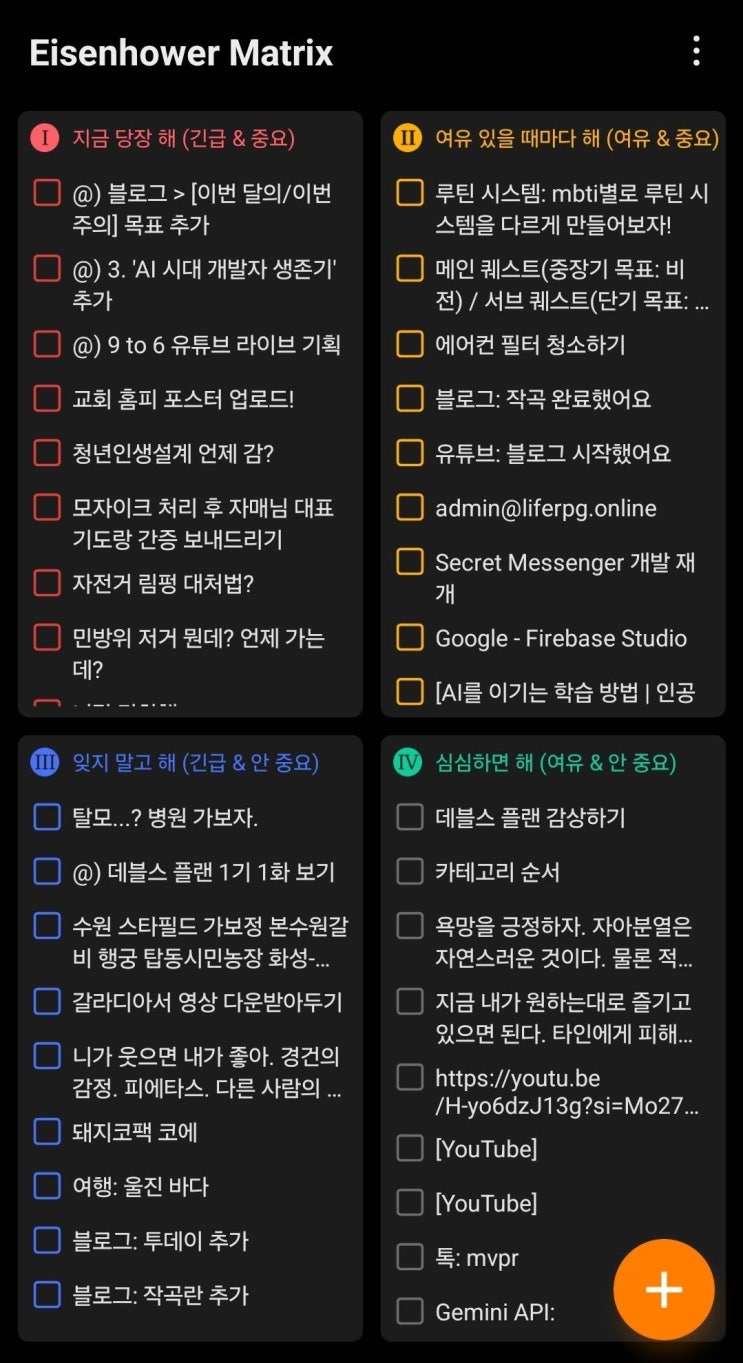
The image above shows how I used the “Eisenhower Matrix” feature built into TickTick, a task/schedule management app.
But reality was different. Taking the tasks that poured in every day and asking one by one, “Is this important? Is this urgent?” before placing them into quadrants was much more annoying and draining than I expected. Even though I had assigned shortcuts!
In the end, I stopped being able to use this excellent framework properly. I simply dumped every task into the “Inbox,” then pinned a few that seemed relatively important to the top using the “Pin” feature. Priority management disappeared, and I found myself facing a long, vague todo list again.
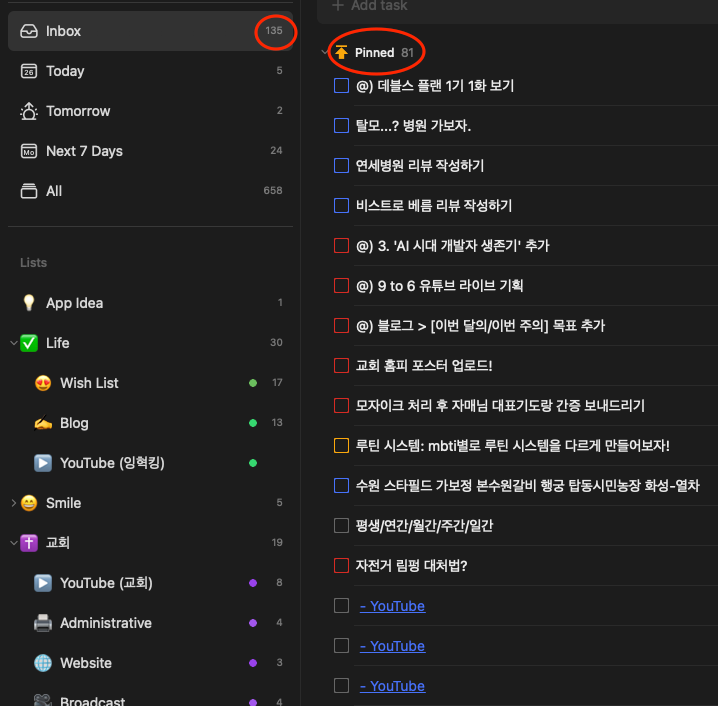
This limitation and annoyance of “manual priority setting.”
That is the direct reason I came up with the “Two-Track Routine System.”
How does the Two-Track System redefine priorities?
This system does not merely list priorities. It completely separates work into two tracks according to the “nature” of the task.
- Track 1: Todo Management Track (the track for today’s survival and stability)
-
This track handles my “urgency.” Life tasks that make tomorrow’s me suffer if I do not handle them today, like “do laundry” or “go to the bank,” and urgent work that suddenly pops up belong here.
-
The goal of this track is clear. It keeps the foundation of the day stable and prevents unexpected problems from spreading into bigger problems. In other words, it is a track for “survival” and “stability” that keeps today from creaking apart.
- Track 2: Goal Management Track (the track for growth toward the future)
-
This track handles my “importance.” Tasks directly connected to my long-term vision, flowing from “monthly goals -> weekly goals -> daily goals,” belong here.
-
These tasks will not cause a disaster if I do not handle them immediately, but they are the things I can never grow without doing steadily. This is the track for “growth” that builds the future version of me.
Why is the Two-Track System much stronger than the Eisenhower Matrix?
-
It can focus on handling “urgent work”: The existing Eisenhower Matrix method teaches us to ignore “urgent but not important work,” but that is not easy in reality. Instead of ignoring this “urgency,” the “Two-Track System” actively manages it by isolating it in a separate space called the “todo management track.” By handling the work in this track first, we can escape the anxiety and stress caused by urgent tasks and secure a sense of stability.
-
It “protects” time for “important work”: The reason most people fail is that important but not urgent work (growth) is constantly pushed aside by urgent work (survival). The “Two-Track System” creates a dedicated space called the “goal management track,” thereby “protecting” this important work from urgent tasks. It enables strategic time management such as, “Today, I will first handle the ‘todo track’ to regain stability, then focus solely on the ‘goal track’ during the afternoon time I secure.”
-
It presents a “workflow” beyond “classification”: The “Eisenhower Matrix” is closer to a static framework for classifying work. In contrast, the “Two-Track System” presents a clear dynamic workflow: “stabilize the survival track first, then focus on the growth track.” This is far more actionable and powerful than a simple classification table.
In conclusion, what I am designing is not a “matrix” that simply places work into square boxes. It is a true “operating system” that acknowledges the two core elements of life, “survival” and “growth,” creates separate tracks for each, and balances the two. Through this, we will be able to avoid being dragged around by urgency while never losing long-term growth.
This is the reason the “Two-Track Routine System” exists. I will embed this system as a core feature in the service/app I create first as a “routine system designer.”
Leave a comment