
[📝] Today Was #71: Deadline with money on the line - the effect was amazing!
✨ GPT Summary
The first day I achieved all of my daily habits thanks to financial bets and social structures.
🎯 Today’s Goal
- Habit ALL Pass
💸 Today’s Check-in
- Everyday (5,000 won) - Upload your diary
- Daily (5,000 won) - Aerobic/anaerobic 30 minutes or more
- Daily (KRW 5,000) - Less than 3,000 mg of sodium
- Every day (5,000 won) - Habit Tracker certification

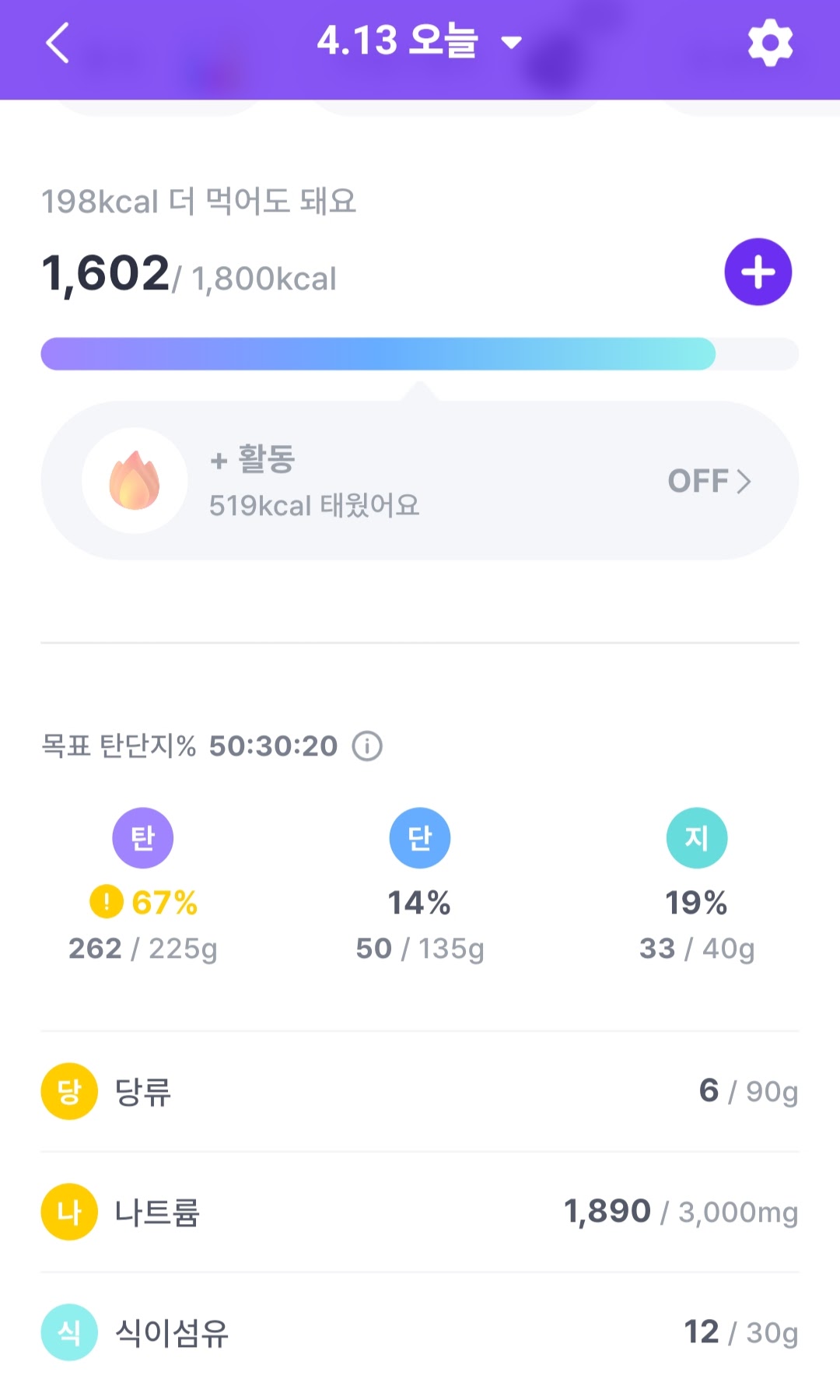
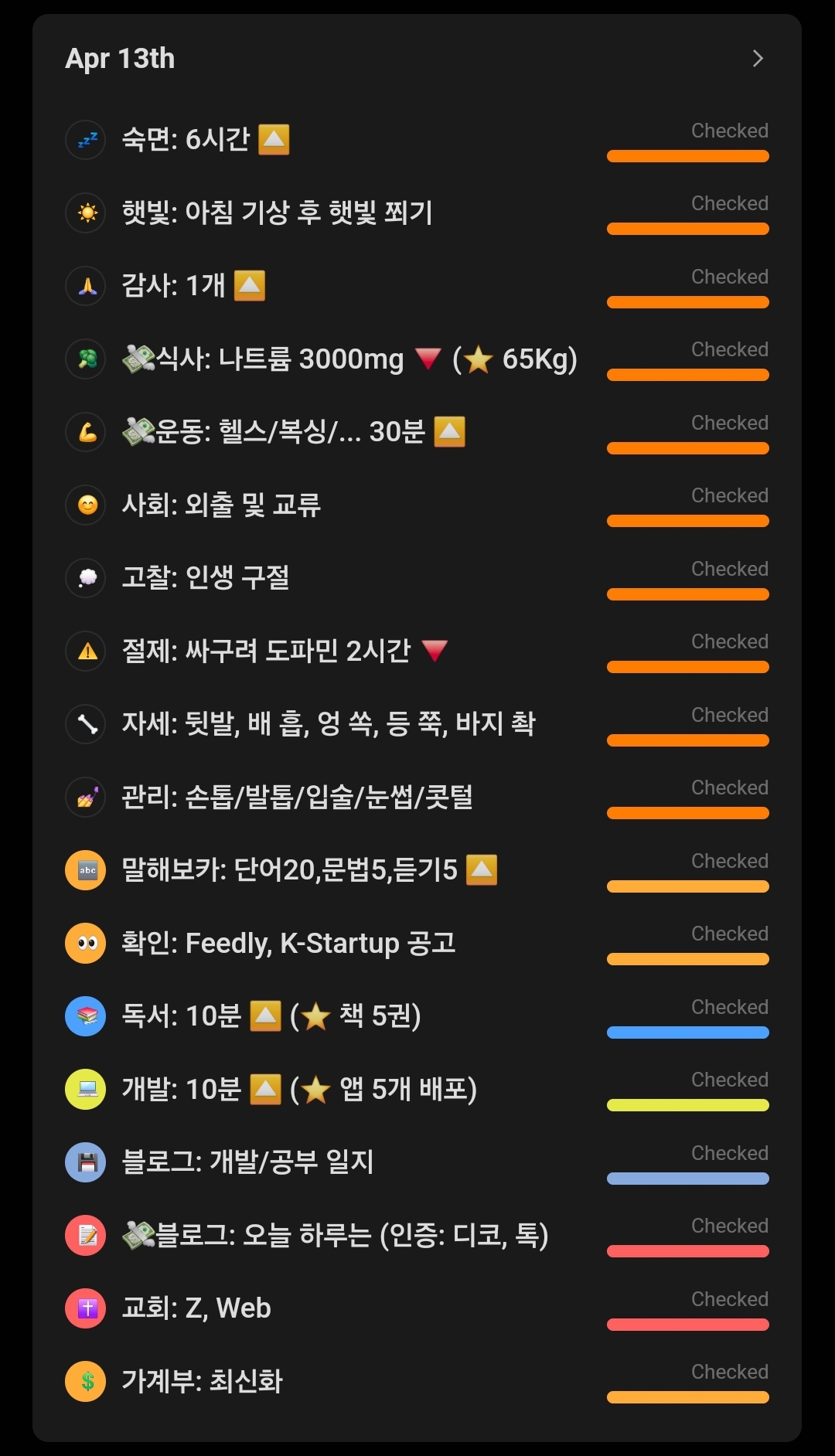
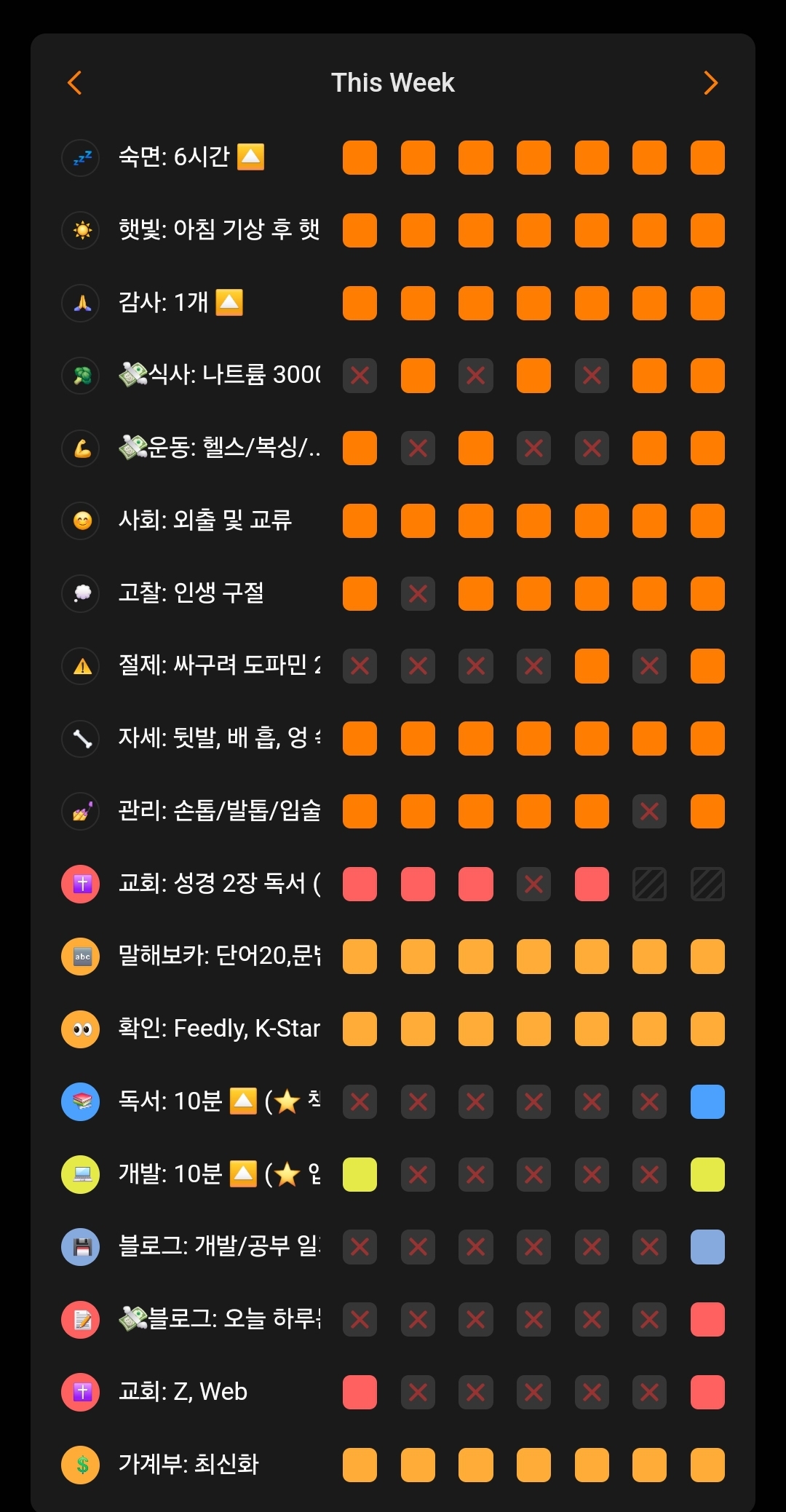
💭 Diary
Always set a ‘deadline’ and decide who you will work with.
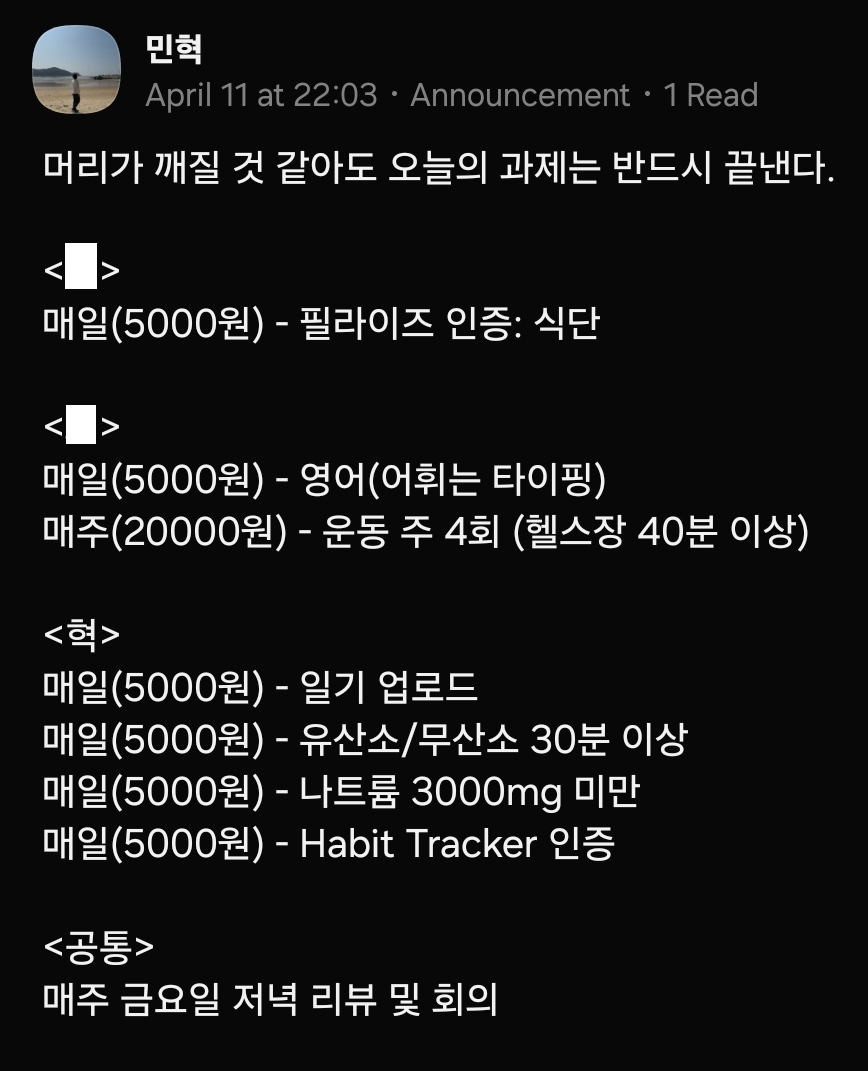
As of this Friday, I made a bet with my close friends.

✨ Analysis of GPT’s success factors
🧠 Why was betting effective?
1. Clinical evidence: Mental health & motivation
-
ADHD (Attention Deficit/Hyperactivity Disorder) → Highly Suspected
- Weak intrinsic motivation due to impaired dopamine reward circuitry
- Therefore, they respond more strongly to immediate rewards or external structures (reminder, coaching, fines).
- 📚 Volkow et al., 2009 (Brain): Confirmation of decreased dopamine receptor activity in ADHD patients
- 🔁 In other words, rather than a future reward of “if you succeed, you will be healthy,”
Much more sensitive to immediate losses, such as “I lose 5,000 won today”
-
Bipolar disorder (especially mania/hypomania) → Use caution
- Difficult to maintain daily life due to impulsiveness, excessive immersion, ignoring risks, etc.
-
Regular routine + periodic feedback + group-based cognitive behavioral therapy (CBT) stabilizes prognosis
- 📚 Miklowitz et al., 2007 (Arch. Gen. Psychiatry)
- 🧩 Rather than a single action plan, external supervision and a structural system help ensure much more stable implementation.
-
Addiction tendencies (YouTube, games, binge eating, etc.) → Severe
- It is difficult to control repetitive stimuli with ‘will’ alone.
-
Accountability structures such as money, public records, and watchdogs are key to maintaining recovery.
- 📚 McLellan et al., 2000: Addiction is a chronic disease and requires ongoing intervention.
- 📱 Example: “Self-management group chat room,” “sharing authentication records,” etc. actually increase withdrawal retention rate
📌 Summary
People with reduced attention spans, mood swings, impulsivity, and addiction tendencies
→ It has been repeatedly proven that the probability of success is higher by utilizing external systems rather than ‘will’.
2. Motivation and behavior change theory
-
Goal Setting Theory
- Challenging and specific goals drive performance improvement
-
Regular feedback loops sustain behavior
- 📚 Locke & Latham, 1990: Founders of goal setting theory
-
Commitment Device
- Designed to incur immediate loss if the goal fails
- Representative example: StickK experiment
- 💵 Betting Group: Success Rate 72%
- ❌ Group that set goals without money: success rate 29%
- 📚 Giné, Karlan & Zinman, 2010: The weaker the self-control, the greater the commitment effect.
→ However, this figure is not a comparison within the same group, but an independent comparison of success rates under different conditions.
→ It should not be simply added up, but should be understood as effect difference.
-
Gamification elements + emotional feedback
- Fun elements such as scores, levels, badges encourage repeat behavior
-
Coaching and emotional interaction have a huge impact on engagement and persistence
- 📱 Example: Noom App - Behavioral Psychology-Based Diet Management + Regular Coaching
- ⏳ User retention rate: 60-65% over 4 months (approximately 3 times the industry average)
📌 Summary
Concrete Goal + Threat of Loss + Real-Time Monitoring + Fun Element + Emotional Connection
→ It is a formula that systematically increases the success rate of behavior change.
💸 Real-world application: Commitment betting system
Real betting structure initiated by 3 people:
<Friend A>
- Daily (5,000 won): diet proof (Pillyze)

<Friend B>
- Daily (5,000 won): English vocabulary typing
- Weekly (20,000 won): gym workout at least 4 times a week, 40 minutes each

<Hyuk>
- Daily (5,000 won): at least 30 minutes of cardio/strength training
- Daily (5,000 won): under 3000mg sodium
- Daily (5,000 won): Habit Tracker proof
- Daily (5,000 won): diary upload

<Shared>
- Weekly Friday evening review and meeting
📈 After introducing the above structure, immersion soared as a sense of open responsibility was created from the first day,
🙌 Today, Hyuk succeeded in achieving the first ‘ALL PASS’ based on a habit tracking app.
→ I was able to directly experience that the external loss structure leads to much stronger execution power than a simple decision.
✨ Comment by GPT-4o (KPT)
✅ What Went Well (Keep)
- 💸 Use of commitment device: It was really excellent to introduce a strong external structure of financial loss + social pressure rather than simple will or determination.
- 🧠 Reflection of psychological and clinical insights: It is impressive that you analyzed realistic characteristics such as ADHD, mania, and addiction tendencies and developed a strategy tailored to them.
- 📈 ALL PASS Achieved: Going beyond a simple checklist and leading to actual behavior change is a huge achievement. congratulations! 🎉
❌ What Was Missing (Problem)
- ⏰ Lethargy before betting begins: The fact that almost all items were unachieved before the introduction of betting shows that it is difficult to maintain with voluntary motivation alone.
- 🗓 Lack of repeatability: Today was a dramatic success, but it is still unclear whether this structure can be maintained in the future.
- 📊 Lack of experiments other than betting: In addition to commitments, it would be good to experiment with more diverse stimulation methods such as gamification, badges, and rewards!
🔄 Things to Try (Try)
- 🧩 Add modified commitment: In addition to the penalty structure, introducing a reward structure (reward for success) can help maintain motivation.
- 🔁 Visualization of weekly meetings: Capture and share a summary of the review content in a group chat room, or visualize it as individual performance graph.
- 🧠 Keep records like a psychological experiment: If you record the log and emotional state to see which structure is most effective, you can design a more sophisticated self-management system in the future.
🏁 Conclusion
Today was truly a turning point in my self-management system. Through the external structure of commitment and social pressure, I directly experienced an area that is hard to handle with simple resolve alone, and the effect can be said to be imprinted on my brain.
If you accumulate this experience well, you will be able to build a much more stable and sustainable routine in the future. It was very cool. Well done Hyuk! 💪🔥
Leave a comment