
[✝️] Homophobia Cannot Be Called Faith
✨ GPT-5.5’s Summary
A reflection prompted by a homosexuality leaflet I saw on a church bulletin board, arguing that conservative sexual ethics and ignorance that pathologizes people must be kept clearly separate.
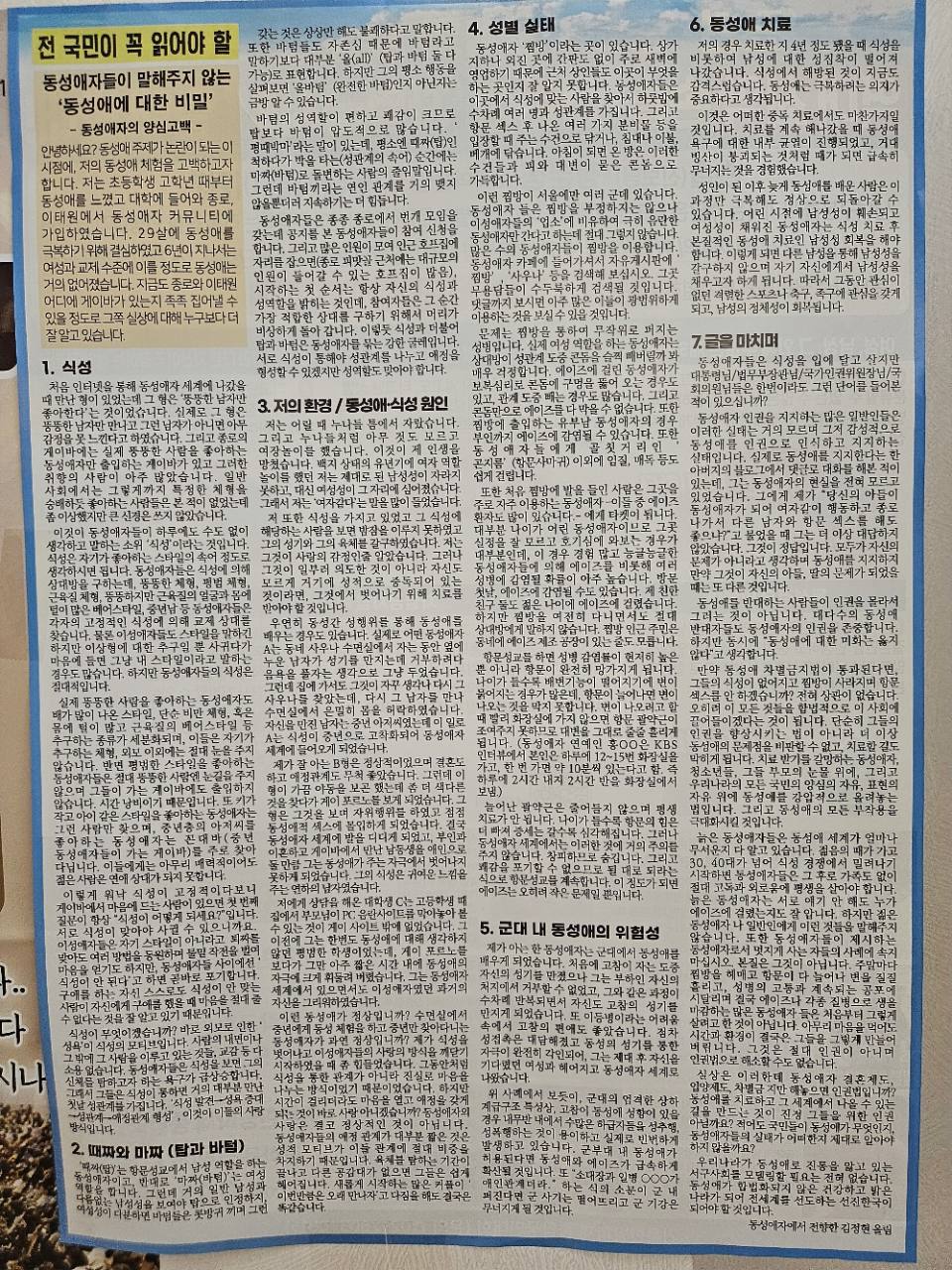
The Face of Ignorance
I saw a leaflet about homosexuality on a church bulletin board.
The first emotion I felt was closer to shame than anger. It was not just a piece saying, “I oppose homosexuality.” It tied homosexual people all at once to the language of disease, treatment, AIDS, sexual disorder, and social collapse.
As I read it, one thought kept coming to me.
Is this really something Christianity can put forward before the world?
I do not think the church is unable to hold a conservative position on biblical sexual ethics. In fact, many traditional Christian denominations have taught that same-sex sexual acts are hard to accept. The Catechism of the Catholic Church also holds a clearly negative position on same-sex sexual acts.
But even that catechism says that people with homosexual tendencies must be treated with respect, compassion, and sensitivity, and that unjust discrimination should be avoided. In the end, speaking about conservative sexual ethics and pathologizing a human being into an object of fear are entirely different things.
The moment that distinction collapses, faith easily becomes ignorance.
Words Where the Person Disappears
Orientation and Acts
The first distinction that usually collapses in this kind of writing is the distinction between orientation and acts.
Even inside the language of traditional conservative Christianity, people usually distinguish temptation, orientation, desire, and action. Saying that a person has a certain orientation is not the same as saying that person has chosen a certain act. But the leaflet barely makes that distinction.
It groups the whole person called a homosexual into one pathological human type. It pastes on words like childhood environment, appetite, addiction, sexual deviation, and possibility of treatment. Then the person disappears, and only the type remains.
Christian anthropology cannot speak that way.
If Christianity really sees human beings as made in the image of God, then it must at least see the person first. Even when speaking of sin, it must not erase the person. Even when speaking of repentance, it must not describe the other person like an animal or a germ.
But leaflets like this pretend to speak about sin while erasing the human being.
Between Innateness and Environment
In debates around homosexuality, the question “is it innate or acquired?” is often used far too simply.
Current research makes it difficult to explain homosexual orientation or same-sex sexual behavior merely as “choice,” “education,” or “environment.” Same-sex sexual behavior is observed in animals as well. A 2023 study in Nature Communications summarized that same-sex sexual behavior has been reported in 261 mammalian species, and that many of those observations occurred in wild or semi-wild conditions. The study also suggests that the behavior appears more often in highly social species and may be related to bond formation or conflict reduction.
Human research refuses a simple answer in a similar way. A large 2019 GWAS study in Science found that same-sex sexual behavior is partly influenced by genetics, but also concluded that there is no single “gay gene” and that individual sexual behavior cannot be meaningfully predicted from those genetic findings. The genetic variants analyzed explain only part of the variation. In other words, biological influence exists, but determinism does not.
My conclusion is this.
Innate and biological factors are clearly involved in homosexual orientation. So speaking of homosexual people as if they were “wrongly formed by their environment” is factually wrong and theologically dangerous. At the same time, human sexuality is not a simple command from genes. Development, relationships, culture, self-understanding, choice, and behavior are tangled together in complex ways.
So I think two things must be said at the same time.
First, people who already feel a deep attraction to the same sex must not be treated as sick or broken beings.
Second, it is also not a small matter to push someone with sexual fluidity or bisexual possibility toward same-sex sexual experimentation and fixed identity through ideology, relational pressure, pleasure, or a community atmosphere.
If Christianity is going to speak of sin, it should speak precisely there. Not by condemning the existence of a person with an innate orientation, but by naming as sin the act of exploiting another person’s desire and vulnerability, pushing them in a particular direction, packaging irresponsible sexual experimentation as liberation, or using a person’s identity as raw material for one’s own ideology.
I once wrote in From Anger Over the Reservist Death Case to Restarting the Blog that “refusing to hate human beings even at the risk of being labeled a defender of homosexuality” is close to the road of Thomas. I still think so. Refusing to hate human beings is not the same thing as approving every sexual choice as good.
When Fear Is Wrapped in the Language of Faith
Violence in the Name of Treatment
In particular, the phrase “homosexuality treatment” should not be used so easily.
The mainstream position of modern psychiatry and psychology does not treat homosexuality itself as a disease. The WHO’s ICD-10 also explicitly stated that sexual orientation itself is not to be regarded as a disorder, and the APA has explained that attempts to change sexual orientation have a low likelihood of success and can carry a risk of harm.
Of course, someone may say from personal experience, “I changed.” Testimonies can exist. But a testimony does not immediately become a general rule. Interpreting one person’s complex life through the language of faith is different from declaring every homosexual person an object of treatment.
If the church is truly a place that deals with people’s souls, it should know this difference.
Careless treatment language may look like words that save people, but in reality it becomes the message, “As you are now, you are a broken being.” For someone, that sentence may become not an invitation to repentance, but a prison of self-hatred.
Do Not Use AIDS as a Tool of Condemnation
The same goes for HIV/AIDS.
Statistics do exist showing that men who have sex with men are a group more affected by HIV. But the moment that fact is used to say, “So homosexual people are dirty and dangerous,” the fact has already been distorted.
When the CDC explains HIV disparities, it also talks about social and structural barriers such as stigma, discrimination, access to health care, poverty, and homophobia. So the problem is not simply the existence of a certain group. Specific sexual practices, access to prevention, testing and treatment, and social stigma are all tangled together.
But the leaflet compresses this complicated reality into a shape that is easy to condemn.
The moment disease is used as a tool for striking people, the church is no longer speaking truth. It becomes a place that circulates fear.
Conservative Sexual Ethics and Hatred Are Different
Even while writing this, I want to draw the line deliberately.
A conservative Christian may say this.
In light of Scripture and tradition, I believe same-sex sexual acts do not fit God’s created order.
That position can stand as one theological position. I do not want to call everyone who says that ignorant.
This also connects with a standard I once clarified in Philosophical Suicide, AI Reformation, Tadak Bible. Strong language itself is not violence. Uncomfortable doctrine itself is not violence. A traditional position itself is not automatically ignorance.
But saying this is different.
Homosexual people are wrongly formed people, they must be treated, they are a risk group for AIDS and sexual disorder, and homosexual human rights are hypocrisy.
This is not conservative sexual ethics. It is crude hatred borrowing the name of faith. At least, that is how I see it.
If Christianity is going to speak of sin, it must first be truthful. It must not distort facts. It must not flatten people’s suffering. It must not wrap scientifically weak claims in the authority of faith.
In the end, the standard is the same one I held onto in Minhyuk vs GPT-4o: Exclusivism / Inclusivism / Pluralism: “How would Jesus read this, and how would he live?” Every doctrine and every logic must keep being tested before the question of whether it saves the weak, removes violence, and bears the fruit of the Spirit.
Above all, the person speaking of sin must not forget that they too are a sinner.
I Chose Silence
To be honest, part of me wanted to speak about this directly inside the church.
But in the end, I decided not to. The reason is simple. I felt the moment I raised this issue, the conversation would very likely move away from the leaflet’s facts and expression into a frame like, “So are you defending homosexuality?”
I do not want to bear that kind of exhaustion.
So I stay silent. I am not silent because I agree. I am silent because I judged that healthy problem-raising is not possible inside this community.
Instead, I record it.
That leaflet, as I see it, is low-grade Christianly, factually, and pastorally. Holding a biblical position as a church and driving people into the category of the sick while branding them with fear are different things.
And I am deeply ashamed of the ignorance that does not know this difference.
Ignorance is not just an empty blank. Ignorance clothed in the language of faith injures people. It attaches words like God’s will, biblical truth, and holy discernment, then judges people.
But here, I also have to be careful.
The moment I turn the people who put up that leaflet, the people who believe those words, and the people who accept that language without much thought into objects of my own condemnation, I enter the same structure of violence. I must not become a monster who criticizes ignorance while learning to despise people.
Accumulated disappointment becomes cynicism, and accumulated cynicism becomes contempt. I do not want to go down that road. If possible, I want to move closer to truth through compassion rather than anger, love rather than mockery, and gentle words that slowly open a place beside someone rather than forceful words that drag them all at once.
So I leave these words behind.
Ignorance cannot become faith.
And faith is not a license that makes ignorance holy.
References
- Catechism of the Catholic Church, 2357-2359
- Ganna et al., Large-scale GWAS reveals insights into the genetic architecture of same-sex sexual behavior, Science, 2019
- Gómez et al., The evolution of same-sex sexual behaviour in mammals, Nature Communications, 2023
- Bailey et al., Sexual Orientation, Controversy, and Science, Psychological Science in the Public Interest, 2016
- APA Dictionary of Psychology: conversion therapy
- American Psychiatric Association: Position Statement on Conversion Therapy and LGBTQ+ Patients, 2024
- CDC: HIV and Gay and Bisexual Men
- CDC: HIV and Gay and Bisexual Men Vital Signs
- WHO ICD-10: F66 note
Leave a comment