
[📚] The Skill of Willpower Design: Why a Random Blind Date Ticket Is More Appealing Than a 50,000 Won Fine (Diet Secret)
✨ Summary by Gemini 2.5 Pro
Recently, I set two challenges for myself. Objectively, both have the same penalty for failure. But strangely, all my focus and passion are drawn to goal number 2. Why is that? As I dug into this phenomenon, I came to think again about the essence of ‘willpower.’
- Original: http://blog.naver.com/hyeogikarp/223949712037
- Naver publication time: 2025/07/28 12:49 KST
- Original category: Self-development
Original Post
Recently, I set two challenges for myself.
-
Lose 1 kg within 1 week. (50,000 won fine if I fail)
-
Build a SaaS and submit it for review within 2 weeks. (50,000 won fine if I fail, receive a Magikarp figure as a gift if I succeed)
Objectively, both have the same penalty for failure. But strangely, all my focus and passion are drawn to goal number 2. Why is that? As I dug into this phenomenon, I came to think again about the essence of “willpower.”
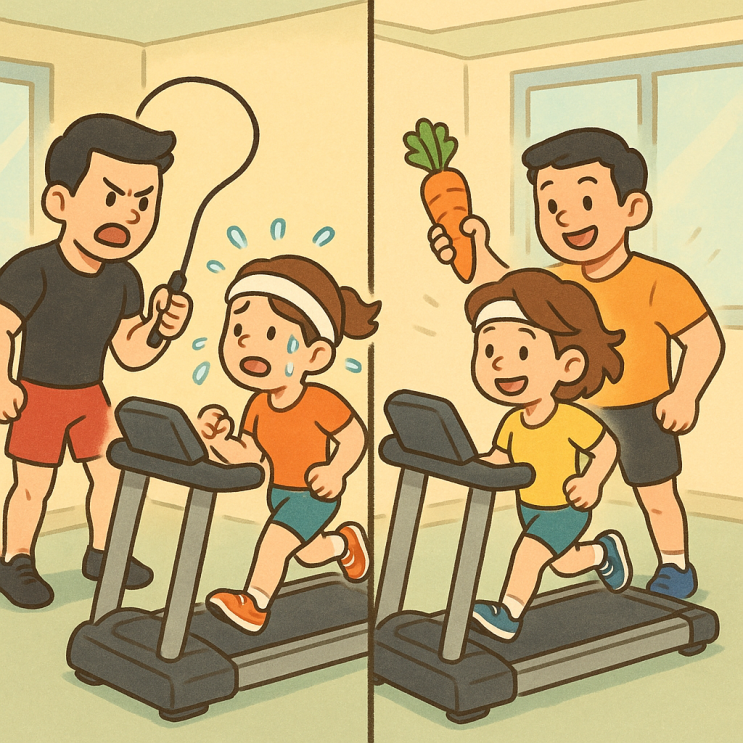
The force that makes us continue a behavior is not the commonly imagined “power to endure and hold out.” Rather, it is determined by the “reward” obtained as the result of the behavior. Here, rewards can be divided into two types.
-
A reward that follows causally according to effort. This is the enjoyment of the behavior itself or a natural positive result. In my case, the process of coming up with ideas and developing them is tremendously enjoyable.
-
A reward artificially assigned according to effort. This is where a really interesting point appears. Even if I look only at artificial rewards, “receiving a 20,000 won Magikarp figure” is far more appealing than “not paying a 50,000 won fine.” It means that gaining even a small benefit stimulates my brain more strongly than avoiding a loss.
This is why challenge number 2 had no choice but to feel overwhelmingly more attractive. Its causal reward is overwhelmingly strong, and its artificial reward is also set attractively.
Of course, this artificial reward has clear limits in itself. But its strategic value is enormous. That is because it serves as a “bridge” that gets me through the “early stage of habit formation,” when the causal reward is not yet felt. In other words, if I use artificial rewards appropriately and repeat the behavior, eventually there comes a point when I feel the causal reward brought by that behavior (for example, health and confidence gained after losing 10 kg through dieting). When that moment arrives, the behavior enters a virtuous cycle that runs on its own even without artificial rewards.
All of this is because our brains are designed as “reward-based learning” systems. Positive experiences release dopamine and reinforce behavior, while forcing oneself to endure only consumes cognitive energy.
Based on this analysis, I tried one thought experiment. What would happen if I connected a powerful artificial reward to dieting, a goal whose causal reward feels weak?
-
Lose 1 kg within 1 week. (50,000 won fine if I fail, random blind date ticket if I succeed)
-
Build a SaaS and submit it for review within 2 weeks. (50,000 won fine if I fail, random blind date ticket if I succeed)
An amazing change occurred. Now number 1 also looks very attractive. With a reward like that, I feel like I could lose 2 kg in one week right now lol.
A reward like a “random blind date ticket” becomes a powerful bridge that helps me endure the difficult process of dieting. If I cross this bridge, reach the land of habit, and begin to taste the causal reward of weight loss, then dieting will inevitably lead to success. This is the best physically and mentally healthy diet secret I have found.
This realization will become the core philosophy of the Life RPG (liferpg.online) gamification app I will build in the future. Beyond simply presenting rewards, I need to help design the journey so users can advance through artificial rewards to the stage where they feel causal rewards.
Leave a comment