
[✝️] I Decided to Act as If God Exists
✨ Summary by Gemini 2.5 Pro
I am by nature someone who values deep thought and reason. A world visible to the eye, provable, and explained through logical cause and effect. That was the form of the worldview I believed to be safest and most rational. Naturally, I understood the world based on materialism, and lived thinking that saying ‘God does not exist’ was the honest attitude of an intellectual.
- Original: http://blog.naver.com/hyeogikarp/223913297586
- Naver published at: 2025/06/27 08:59 KST
- Original category: Religion
Original
I am by nature someone who values deep thought and reason. A world visible to the eye, provable, and explained through logical cause and effect. That was the form of the worldview I believed to be safest and most rational. Naturally, I understood the world based on materialism, and lived thinking that saying “God does not exist” was the honest attitude of an intellectual.
But there were questions that cracked the wall of my reason. Love, altruism, beauty, and the existence of consciousness are hard to explain with pure materialism alone. At the end of these concerns, I decided to acknowledge two facts. First, that believing in what cannot be seen can sometimes be the most practical and “rational choice.” Second, that the sense of belonging and purpose given by a life of faith in God, and the framework for interpreting suffering, may perhaps make human beings happier.
These concerns eventually lead to the question of “reality.” Whether one believes this world is inside a simulation like “The Matrix,” or that I am nothing but a “brain in a vat” and every sensation is merely an electrical signal, that is an individual’s freedom. Because it cannot be proven anyway. The debate over whether God exists is the same.
Therefore, rather than debating an unprovable reality, I decided to focus on the practical question: “What meaning and happiness does believing in this way bring to my life?”
My new perspective starts here. God may not physically “exist” in the external world I experience. But as influence on my inner world, that is, on my thoughts and heart, God can be “real” in practice. An existence not as physical reality, but as psychological reality. That is the image of God I am trying to hold onto.
To add a little more, it is like this. I think the “God” human beings have imagined and spoken of is like the swarm intelligence of ants or bees. Each individual only moves according to simple rules, but the countless movements gather and appear as if one enormous intelligence or will exists. The accumulated sum of humanity’s history and culture, and countless individuals’ wishes, layered upon one another: that is another image of God as I understand Him.
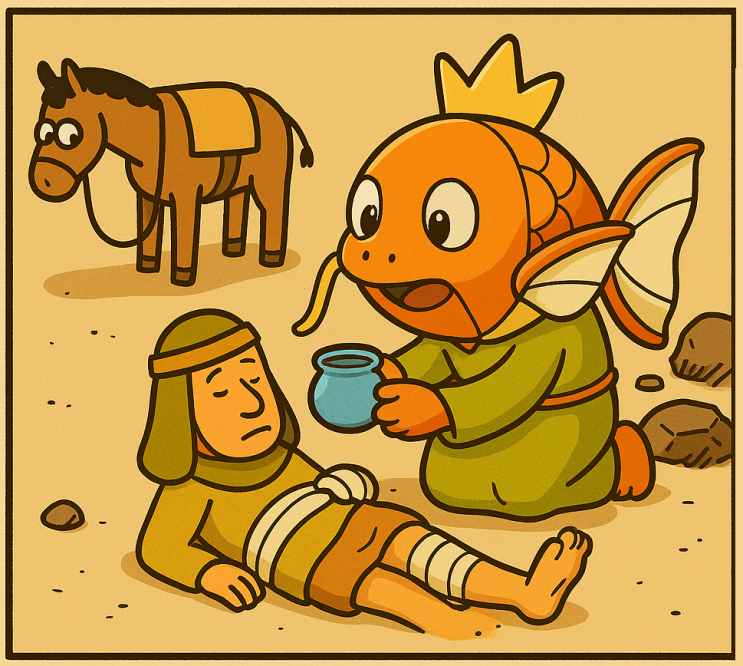
So I concluded that I would begin the greatest experiment of my life. Instead of “proving” God’s existence, I would choose “faith toward what cannot be proven.” I would act “as if God exists” and experience with my whole body where that life leads me. As the first step, I resolved to pray to God every day and live a life loving my neighbors as my own body.
Of course, this path will not be easy. I too will experience the anguish of Jordan Peterson crossing from doubtful intellectual to person of faith, and the doubt of the apostle Thomas who said he would believe only if he touched.
Maybe, who knows. If I keep doubting and acting like that, one day, even if later than others, I may walk the narrow path of a faith deeper than anyone else’s precisely because I doubted more fiercely than anyone.
I decided to stake my life on that possibility.




Leave a comment